
Contending with Insects
Biting insects can be the bane of outdoor activities. Desperately looking for a silver lining, I have heard it said that mosquitoes are what keep the wilderness wild, so if you can learn to deal with hordes of bugs you can avoid hordes of people! I have dealt with way more insects than I would like, and have some thoughts on how to manage with them.
First though, an overview of the enemy. There are 4 categories of biting insects that I have found to be an issue in the Canadian backcountry (since ticks are technically not insects I will leave them for another day).
- first are no-see-ums. These have caused me the least trouble, in fact the only time I have had a problem with them was in the early years when I was using a cheap A-frame tent that did not have no-see-um netting. On the Saskatchewan/Alberta Clearwater River we got eaten alive at night, and right after the trip I bought a much better tent with no-see-um netting! No-see-ums are very small and light, and don't fly very fast, so any wind will ground them. Hence they are generally only a potential problem in camp.
- a somewhat bigger problem are deer and horse flies. They come in (relatively) smaller numbers, but I have heard their bite described as "like someone giving you a playful tweak with a pair of pliers". An exaggeration, but you will take notice when you are bitten! These guys are heavier and more mobile than any of the others and will follow you during the day even in a breeze, but they like the heat and I have found they don't tend to be a big problem in the morning or evening around camp.
- next are mosquitoes, and now we are getting into more of a challenge. How big a problem they are depends on how much you react to the bites, but when the are bad they can be so thick they are impossible to ignore even if you don't tend to react. Mosquitoes are at their worst when it is calm and humid, so often around camp.
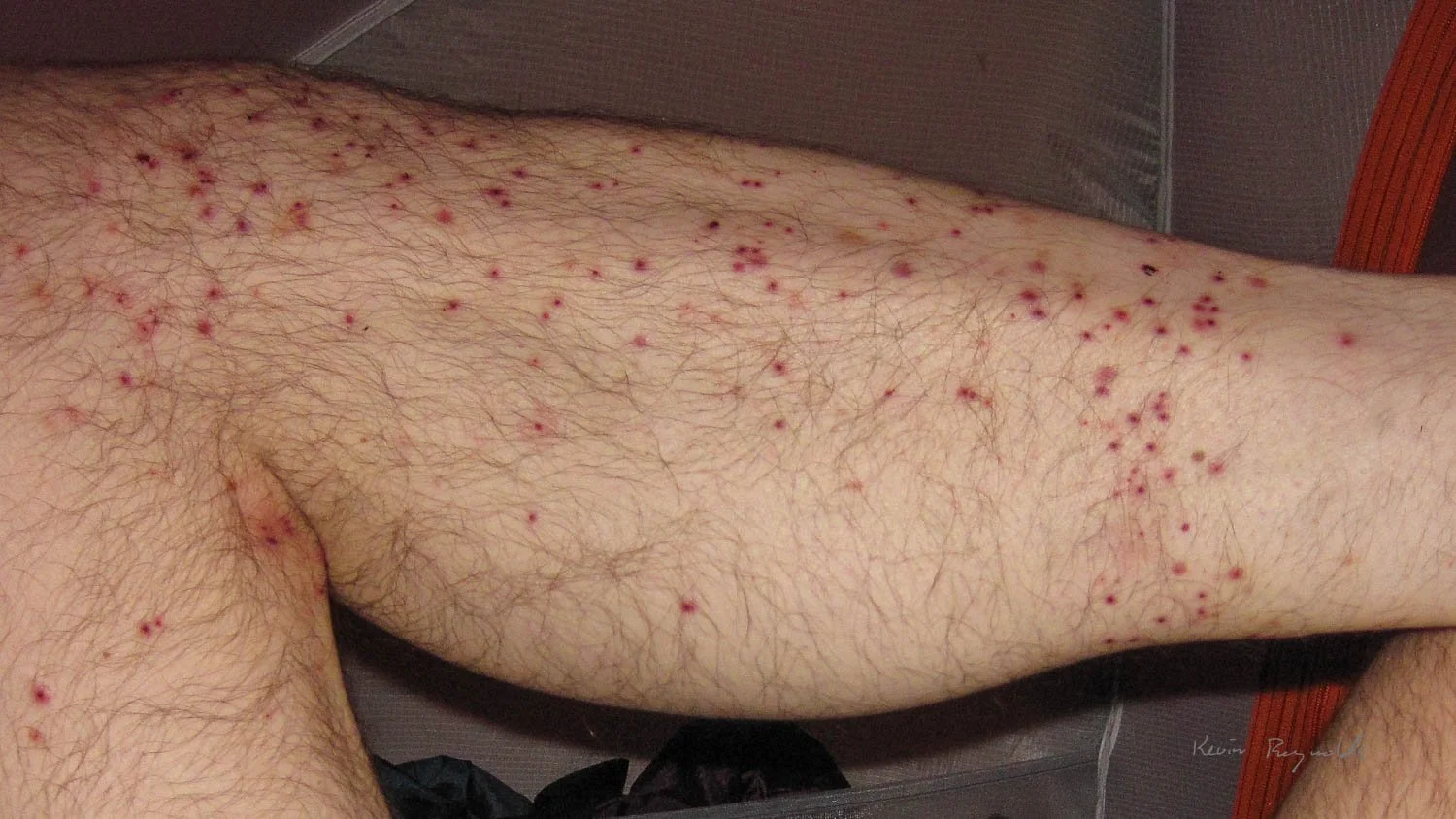
Blackfly bites after not fully tucking my pants into my socks
- for me black flies are the worst of the lot. While the others all tend to fly in for the attack and bite where they land, black flies will land and then crawl around looking for an opening to get at your flesh. Their bite is almost unnoticeable, but hours later develops into a persistent itch. And like mosquitoes, they can come in swarms, but unlike mosquitoes they seem to be more active during the day.
So, how to deal with these pests? I have grouped my thoughts into 3 general areas: steer clear, physical barrier, and chemical warfare.
The first line of defense is to steer clear of the bugs if possible. This means knowing when and/or where the insects are likely to be bad and trying to avoid these places/times. If you stick to snowshoeing you will not have insect problems! However we all want to get out during the other seasons, so generally avoiding insects requires an awareness of their lifecycles.
Mosquitoes, deer flies and no-see-ums breed in stagnant water, so areas with marshes, bogs, swamps and the like will tend to have these insects. Black flies breed in moving, aerated water so areas with fast moving creeks and rivers will have more of them. However in my experience the population of each of these insect groups is also seasonal. Back flies typically are at their worst for about a month and a half, starting a few weeks after ice breakup. Mosquitoes arrive in force a few weeks after the black flies, and are usually pretty thick for a couple of months. No-see-ums are similar. Deer and horse flies are more of a summer critter and in my experience hang around later in the year than the others.
So what do you do with this information? First, late summer and fall are almost always going to have fewer insects than spring and early summer. Next, places with good drainage can be almost bug free after black fly season (like mountains without broad wet valleys). Dry areas like deserts will also be better, but be aware that many areas of the prairie have many sloughs and potholes and are not as dry as you might think. When camping, look for windy locations since most of these insects don't handle wind well.
If you can't avoid the insects, due either to your schedule or desired location or both, then my suggestion is that the next line of defense should be physical barriers.
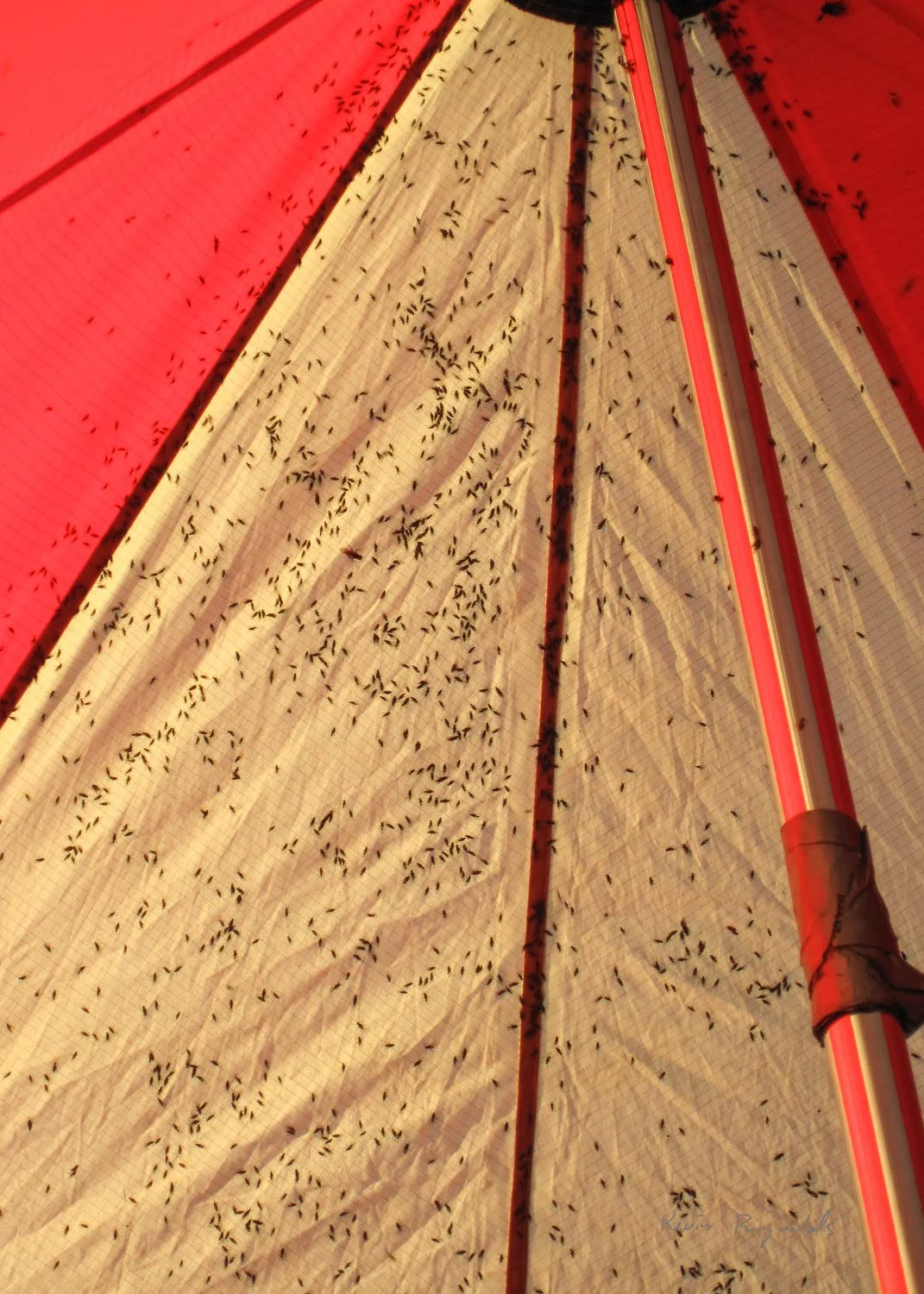
Blackflies move to the top of the dining tent instead of biting
First make sure you have a tent with no-see-um netting. It is easier to tolerate bugs during the day if you know you will have a break at night. With a reasonable tent, as long as you are quick to get in and out, a short murder spree should yield a night free of insects. As a side note, for reasons I don't understand, black flies in an enclosed space will go to the top and not pursue you which is very nice if you end up with a bunch in the tent.
The next step is to make sure your clothing covers as much of you as possible (including a hat). Even lightweight clothing will usually be enough for mosquitoes and deer flies if you are largely covered, but most clothing won't slow down black flies as they will crawl around to find openings and a nice quiet spot to dine.
If the mosquitoes are very thick then it is time to add a headnet to your ensemble to keep them out of your face. If you are fully clothed then I have always found adding a headnet to be enough to manage mozzies.
If you are having significant black fly problems, then it is time to break out the bug jacket. If you tuck your pants into your socks and snug up the waist and wrist bands on the bug jacket then the little devils only have access to your hands, which is usually a manageable problem.
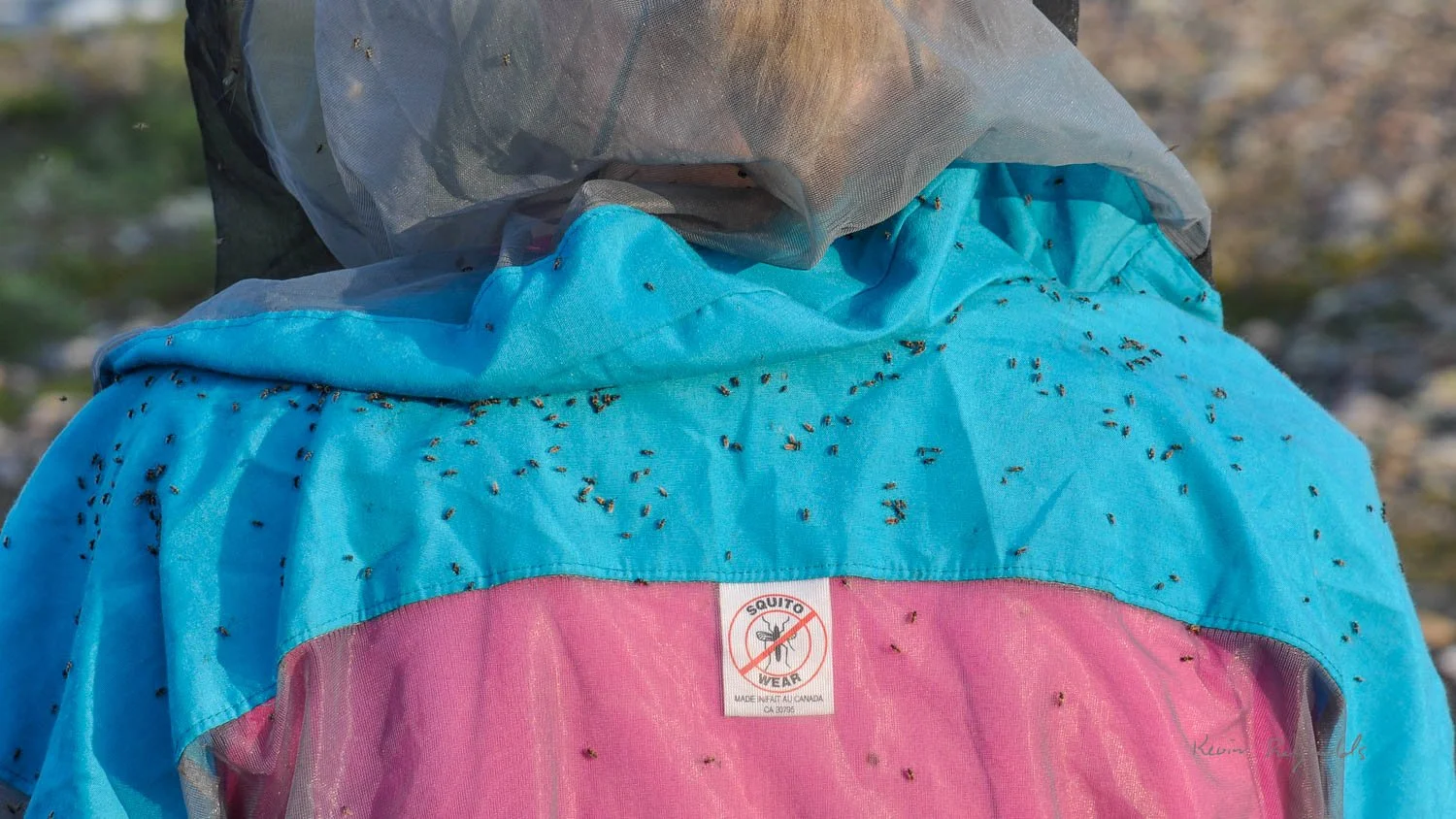
A bug jacket will keep blackflies at bay
The final option is to go chemical. I am not a fan of insect repellents for several reasons. First, in the past deet has been the only effective repellent for really bad bugs and deet will melt many synthetic materials. If you are not careful you can end up with anything from holes in your tent to damaged glasses. None of this is good when you are in the wilderness (on the plus side, I have used deet to remove spruce sap from my hands, works like a charm!). Second, in the backcountry washing on a cold night can sometimes be very unpleasant or impossible, and crawling into a sleeping bag covered in bug dope does not set you up for a good night.
That said, I have used repellent when my wrists were getting mauled by back flies while I took pictures, and I would never do a remote trip without carrying some. There is a relatively new repellent, icaridin, that is supposed to be equally as effective as deet and which does not melt plastics. Icaridin is what I now carry in case I do need to resort to repellent, although I have not had a chance test it with truly horrific bugs.
Insects have the potential to turn paradise into a nightmare, but with planning and the right equipment you do not have to let them stop you from getting out there and having a great time!