
There are two schools of thought about tents: lightness rules or functionality rules. I fall squarely into the second camp which I think makes sense for paddling trips (if you are a backpacker you might want to look elsewhere for tenting advice…).
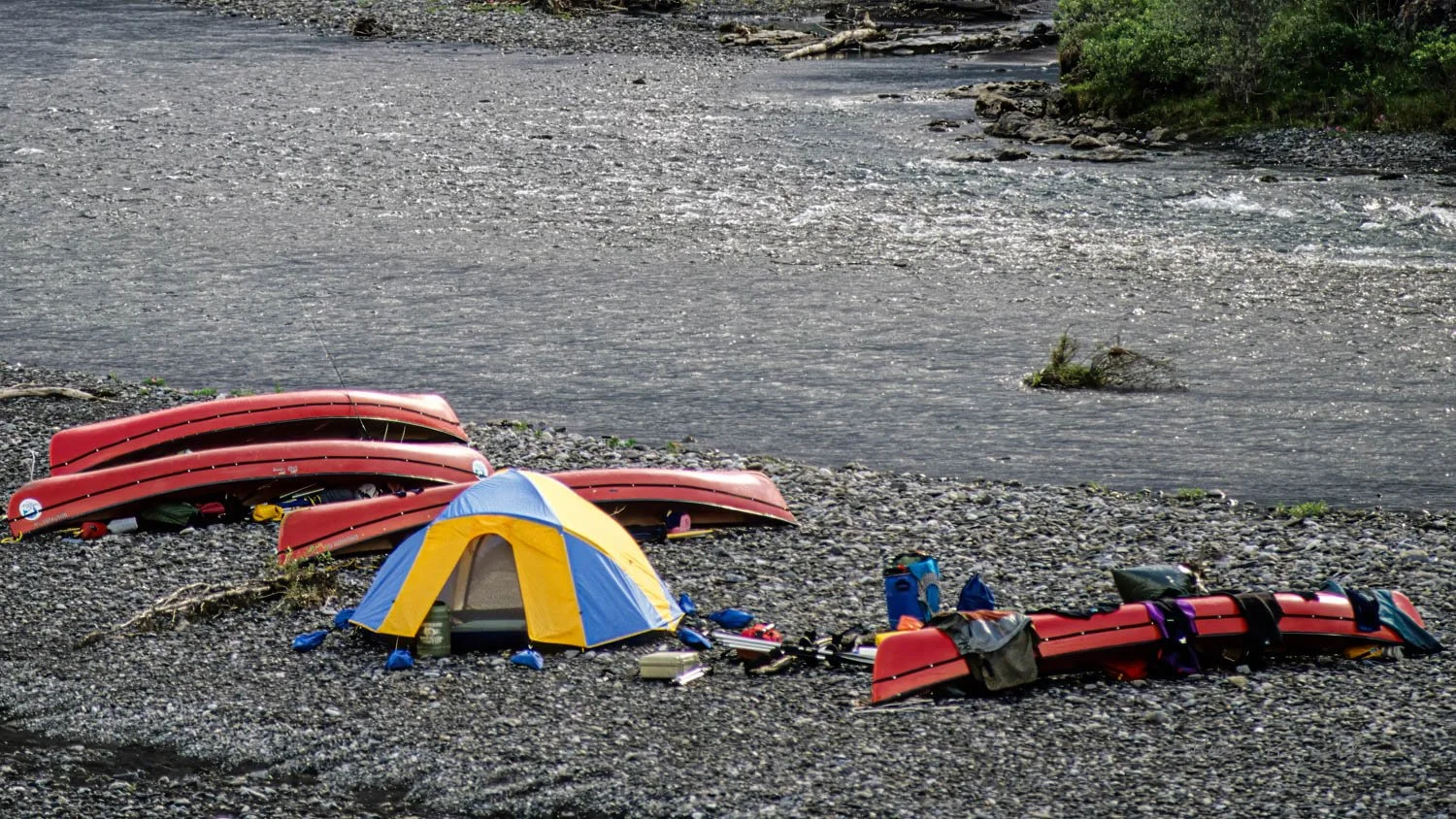
A typical tent site on mountain rivers.
Key factors to consider when choosing a suitable tent for a trip are space, ruggedness, water resistance, ease of setup/teardown, and portability. What weight you give to each of these will depend on the type of trip you are doing (short or long, warm or cold, protected or exposed, etc). Below I will outline how and why I weight each of these and then summarize a few tips I have learned over the years.
SPACE
To me this is one of the key things I look for in a tent, partly because I am reasonably tall. So the first consideration is can you lie down without having your head and feet push up against the ends of the tent. To me this is critical, since if you are up against the tent fabric you will get more water drips on you from condensation on the fly, and skitters will sound like they are right in your ears (and they may even be able to bite you through the fabric).
The next consideration is whether there is some elbow room in your tent when you are also in there. Unless you are very friendly with your tent-mates, a 2 person tent is only good for 1 person, or a 3 person tent for 2 people. A huge advantage of having this extra space is that you can keep some gear in the tent with you so you don't have to open the tent to bugs if you want to change clothes (of course you would never bring food, toothpaste, or anything a bear might consider food into the tent!). Note that the size of vestibules is also important as they let you keep gear dry that you don't bring into the tent (shoes, packs, life jackets, etc).
Finally, if the weather is bad it is far more comfortable to spend time in a tent with a bit of extra room. Of course I always bring a tarp to expand living space outside the tent, but leaving a tarp up in stormy weather can be dodgy.
RUGGEDNESS
This is another key factor in choosing a tent. If you are doing a long trip, in a remote area, with exposed sites and potentially harsh weather, this is probably the most important factor. If you are on a short trip with a good weather forecast and protected sites it is much less important. Ruggedness is a complex function of materials used and tent design, and I would suggest looking at tent reviews for specifics on a given tent. However there are some generalities, like pole sleeves are a more rugged type of design than clips, tents with more guy points are more stable than those with less, and all else being equal heavier tents are more rugged than light ones. Typically 4 season tents will be more rugged than 3 season tents.
WATER RESISTANCE
Water resistance is also determined by the combination of tent design and materials. More water resistant tents will have a fly that comes down to ground, and high waterproof ratings for the tent fly and floor materials. Tents with vestibule designs that protect the doors when entering/exiting will also keep the tent drier.
Unfortunately these same features can make the tent very hot in good weather, so a very rugged, highly water resistant 4 season tent may be a very poor choice for summer camping in warm locations!
EASE OF SETUP/TEARDOWN
To me this is a less important factor, although if you have to set up the tent by yourself in windy conditions it can be a significant issue. Generally a free standing tent will be much easier to set up than one that is not, especially in rocky or sandy areas. If necessary you can also set up a free standing tent in a more convenient location then carry it to your specific tent spot. The other item that is significant here is pole clips vs sleeves, clips are much easier to deal with especially when setting up in the wind (they are also almost universal now). Note that sand/rock bags, described below, make a huge difference in how easy it is to guy out a tent.
PORTABILITY
For me, for paddling, this is almost a non issue unless you have extensive portaging to do, or extreme weight restrictions for a fly in trip. There is some benefit to a tent with a smaller packed size for longer trips where you have to bring a lot of gear, but typically for these trips the tent ruggedness is more critical. I would rather do an extra trip over the portage trail than spend a week or more in a busted tent! Of course if you are backpacking you will have a different view on portability...
TIPS
A few things I have learned about tents and tenting over the years.
- rock/sand bags are invaluable in sandy or rocky terrain. These are simple bags with a clip at the opening that you can fill with sand or rocks and use to hold out the tent guy lines. I have made my own, key things to consider are the durability of the material (rocks are abrasive and sharp), a wide opening to get reasonable sized rocks in and back out, and a reflective patch to avoid tripping on them at night. Note that in my experience you do not need to close the opening, and uncoated (not waterproofed) fabric is better as it dries faster. These are very light and compact: I can put 8 into the top of the tent bag with minimal impact on weight or size.
Rock bag V1 (blue) and V2 (tan)
Rock bags by flashlight
- a ground sheet is very important in most backcountry settings. Though tent floors are typically waterproof, they are not puncture proof and a ground sheet will protect the tent from sharp sticks and rocks on the site. I have tried the light weight custom fitted ground sheets but have gone back to the simple Canadian Tire poly tarps, somewhat heavier and bulkier but much more rugged (I have a custom sheet with many slices and punctures). Note that with a non-fitted sheet you have to be very careful to tuck any exposed groundsheet under the tent or it will funnel rain under your tent!
- before a trip it is critical to test you tent to make sure you have all the bits and that it is still waterproof. The seam tape will delaminate over time, and the polyester urethane (PU) coatings that are most commonly used for tent flys and floors will degrade into a sticky mess in 5 to 10 years (you will get more life if you dry your tent thoroughly before storing it). Don't assume that because your tent was fine last season it will still be good this one!
- a small 'doormat' helps keep the tent clean. A small nylon sheet that you put in front of the tent door will reduce the amount of sand, pine needles, etc that you drag into the tent. It is very light and can just be jammed into the tent bag.